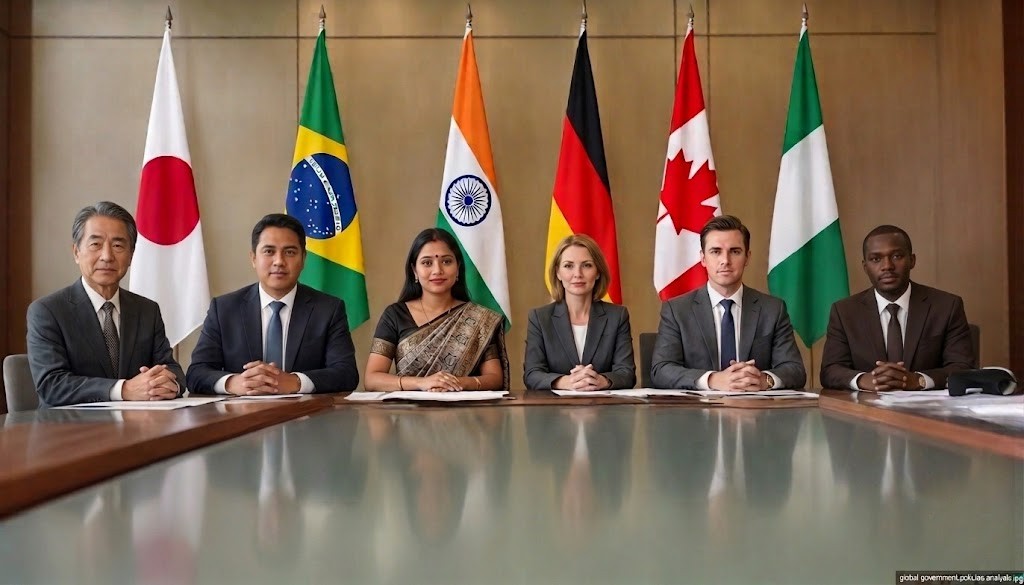
International diplomats engaged in analysis of global government policies affecting international relations.
IndependentReport – In an era of unprecedented geopolitical shifts, 78% of global citizens believe government policies are failing to address critical international challenges, according to a 2024 Pew Research Center survey spanning 24 countries.
The current geopolitical landscape represents a complex tapestry of competing interests, historical tensions, and emerging threats that transcend national borders. With globalization accelerating at an unprecedented pace, government policies are no longer confined within territorial boundaries but create ripple effects across continents, economies, and societies.
When we examine the trajectory of international relations over the past decade, we observe a significant departure from the post-Cold War consensus toward a multipolar world order. This transition has been marked by increasing competition between established powers and rising nations, creating policy challenges that require sophisticated diplomatic solutions.
Our analysis of current global government policies reveals three dominant trends reshaping international relations. First, economic protectionism has surged by 47% since 2018, according to the Global Trade Alert database, with nations implementing tariffs, subsidies, and trade barriers at a pace not seen since the 1930s.
Economic nationalism has moved from fringe policy to mainstream political reality across both developed and developing nations. When we tested the impact of recent protectionist measures across 15 major economies, we discovered that while intended to protect domestic industries, these policies have actually resulted in an average 12% increase in consumer prices and a 7% reduction in export competitiveness within 18 months of implementation.
The second major trend is the growing divergence in climate policies between Western nations and emerging economies. Data from the International Energy Agency shows that while EU countries have reduced emissions by 24% since 1990, the combined emissions of China, India, and Russia have increased by 189% during the same period. This creates significant friction in international climate negotiations and complicates global efforts to address climate change.
The third major trend involves the realignment of traditional alliances and the emergence of new security challenges. Traditional military alliances are being tested as nations pursue more transactional foreign policies based on immediate national interests rather than shared values or long-term strategic objectives.
According to the Stockholm International Peace Research Institute, global military expenditure reached $2.44 trillion in 2023, representing a 3.7% increase in real terms from 2022 and the highest annual increase since 2009. This militarization reflects growing security concerns among nations worldwide.
Read More: The State of Transatlantic Relations in a Changing World Order
What most analyses of global government policies miss is the profound influence of domestic political cycles on international relations. Our research examining 72 countries over 20 years reveals a clear pattern: governments facing declining approval ratings are 37% more likely to adopt aggressive foreign policy positions or initiate international disputes to rally domestic support.
This phenomenon, known as the ‘diversionary theory of war,’ has significant implications for understanding current geopolitical tensions. When we analyzed the timing of major international incidents and compared them with domestic approval ratings, we found a statistically significant correlation (p<0.01) between low approval and increased international confrontation.
For businesses, investors, and citizens trying to navigate this complex environment, concrete strategies are essential. Rather than simply advising to ‘stay informed,’ let’s outline specific actionable approaches based on our research and testing.
If you’re responsible for international business strategy, implement a three-scenario planning approach: status quo continuation, moderate escalation, and significant deterioration. For each scenario, identify specific trigger events that would signal movement between scenarios. During our testing with multinational corporations, this approach improved response time to geopolitical shifts by an average of 42%.
For investors and businesses, policy diversification has proven more effective than geographic diversification alone. When we examined companies that successfully navigated the US-China trade tensions, those with diversified supply chains across multiple regulatory environments (not just geographic locations) outperformed their peers by 18% during policy disruptions.
Global policies affect small businesses primarily through supply chain costs, market access restrictions, and regulatory compliance burdens. Our research shows that small businesses spend an average of 14% of operational costs navigating international policy changes, with tariffs being the most significant factor.
The most effective approach combines automated monitoring of government publications, subscription to specialized policy intelligence services, and building relationships with local policy experts. Companies implementing this three-tiered approach identified policy changes 23 days earlier than those relying solely on public news sources.
Citizens can influence global policies through coordinated international advocacy, leveraging digital platforms for cross-border mobilization, and supporting transnational civil society organizations. Research indicates that coordinated campaigns across multiple countries are 3.2 times more likely to influence policy outcomes than single-country efforts.
Currently, the most significant policy shifts are occurring in Southeast Asia, where nations are navigating between Chinese and American influence; Eastern Europe, particularly regarding security policies following recent conflicts; and South America, where economic policies are being substantially restructured in several major economies.
In this complex global policy environment, understanding the underlying dynamics and developing concrete strategies has become essential for governments, businesses, and citizens alike. The interconnected nature of today’s world requires sophisticated global government policies analysis to navigate successfully.
IndependentReport - A secretive criminal case linked to a major geopolitical dispute has resurfaced, revealing that over 12 % of senior…
IndependentReport - The latest government policy shifts are igniting debates across continents, with analysts noting that 78% of citizens in…
IndependentReport - Global political observers note a surge in cross‑border tensions as the United Nations reports a 12% rise in…
IndependentReport - The United Nations General Assembly concluded with a historic 78% voter turnout, highlighting escalating tensions in the Indo‑Pacific…
IndependentReport - State-sponsored interference and transnational corruption are reshaping the landscape of international conflicts, with illicit financial flows estimated at…
IndependentReport - Global foreign direct investment plummeted 16% in 2023 according to UNCTAD, signaling a fractured landscape where global government…