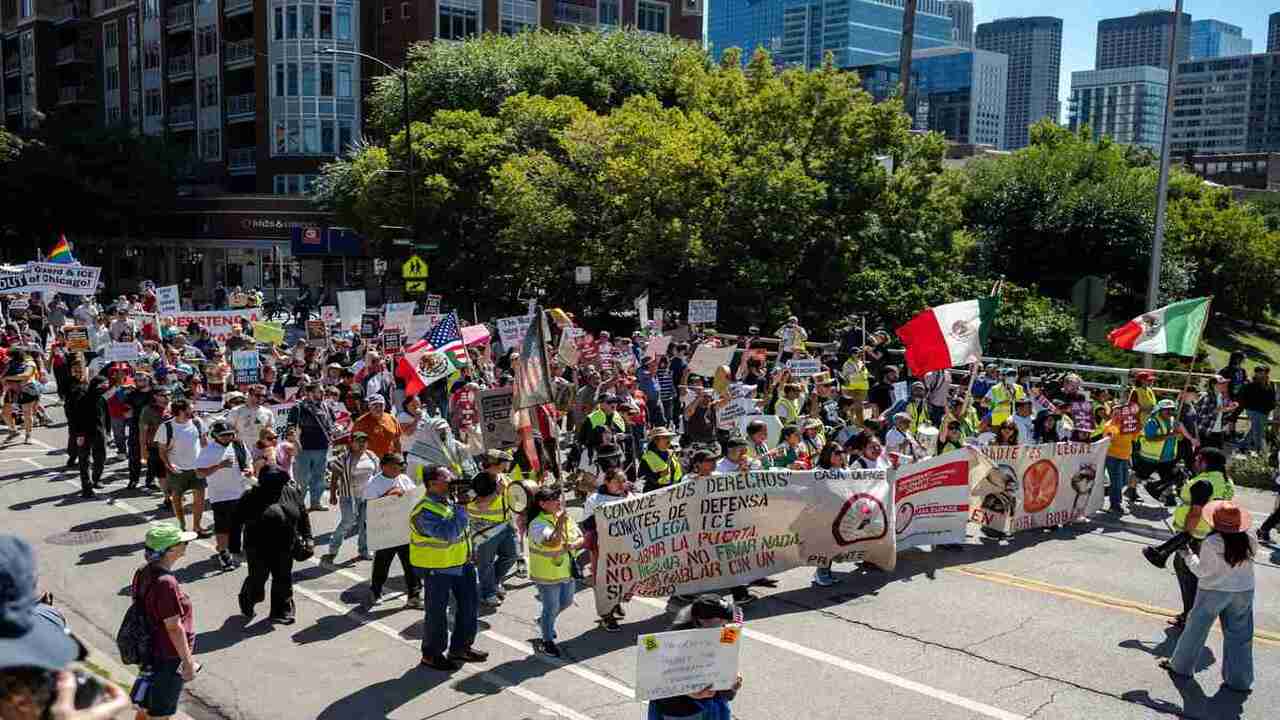
IndependentReport – On September 1, 2025, thousands of Protesters filled the streets of downtown Chicago, voicing strong opposition to the possible deployment of Immigration and Customs Enforcement (ICE) officers and National Guard troops. The demonstration was part of the broader “Workers over Billionaires” rallies held across more than 1,000 U.S. cities. While the theme focused on labor rights, in Chicago the message was clear: residents rejected federal intervention in their community.
Mayor Brandon Johnson emphasized that Chicago would not bow to what he described as intimidation by the federal government. His remarks came amid President Trump’s suggestion that federal troops could be dispatch to curb crime. Local leaders countered by highlighting data showing declining violence rates in the city, arguing that there was no crisis warranting such intervention. For many Chicagoans, the city’s identity as a sanctuary city remains central, and federal enforcement is seen as a violation of that principle.
The tension between Washington and Illinois grew when reports emerged that the Naval Station Great Lakes might serve as a staging ground for ICE operations. This possibility alarmed state officials, including Governor J.B. Pritzker, who stressed that the city and state would resist any move undermining their sanctuary policies.
President Trump insisted that deploying federal resources was necessary for public safety. However, legal scholars and civil rights advocates described it as political theater. Governor Pritzker went further, branding the plan unconstitutional and a direct challenge to the authority of state and local governments. The conflict underscored how immigration and policing have become flashpoints in the broader struggle between federal power and local autonomy.
Read More : Federal Reserve Independence at Risk: Lankford Pushes Back Against Trump
To understand how Chicago’s institutions and residents are reacting, here are the most notable actions and responses:
These actions highlight not only public resistance but also the determination of local leaders to defend municipal governance from outside interference.
Residents and observers fear that introducing military personnel into domestic law enforcement could erode constitutional safeguards. Critics point to the Posse Comitatus Act, which restricts the use of the military in civilian law enforcement except under specific circumstances. Using the National Guard and ICE in sanctuary cities like Chicago Protesters is seen by many as an abuse of executive power rather than a genuine public safety initiative.
The concerns extend beyond legality. Communities worry about the chilling effect on immigrants and minorities who may avoid public spaces or services out of fear. Instead of fostering safety, opponents argue that the presence of troops could create further distrust between residents and law enforcement, undermining years of effort to build community partnerships.
Also Read : Future Tech 2025: Digital Trends That Will Blow Your Mind
Chicago Protesters reflect more than just resistance to a particular policy Future Tech 2025: Digital Trends That Will Blow Your Mind they reveal a deeper struggle over the balance of power in American democracy. When local leaders and communities openly defy federal directives, the debate is not only about immigration but about the role of states and cities in shaping their own futures.
For labor groups, the timing on Labor Day was symbolic. Demonstrators framed the protests as both a defense of workers’ rights and a rejection of corporate and political elites who they say manipulate national policies. In this sense, Chicago’s stance carries implications for other cities that may face similar federal pressures, showing that collective mobilization remains a powerful tool.
IndependentReport - The latest government policy shifts are igniting debates across continents, with analysts noting that 78% of citizens in…
IndependentReport - Global political observers note a surge in cross‑border tensions as the United Nations reports a 12% rise in…
IndependentReport - The United Nations General Assembly concluded with a historic 78% voter turnout, highlighting escalating tensions in the Indo‑Pacific…
IndependentReport - State-sponsored interference and transnational corruption are reshaping the landscape of international conflicts, with illicit financial flows estimated at…
IndependentReport - Global foreign direct investment plummeted 16% in 2023 according to UNCTAD, signaling a fractured landscape where global government…
IndependentReport - The traditional post-Cold War order is unraveling faster than anticipated. Recent data from the International Monetary Fund suggests…