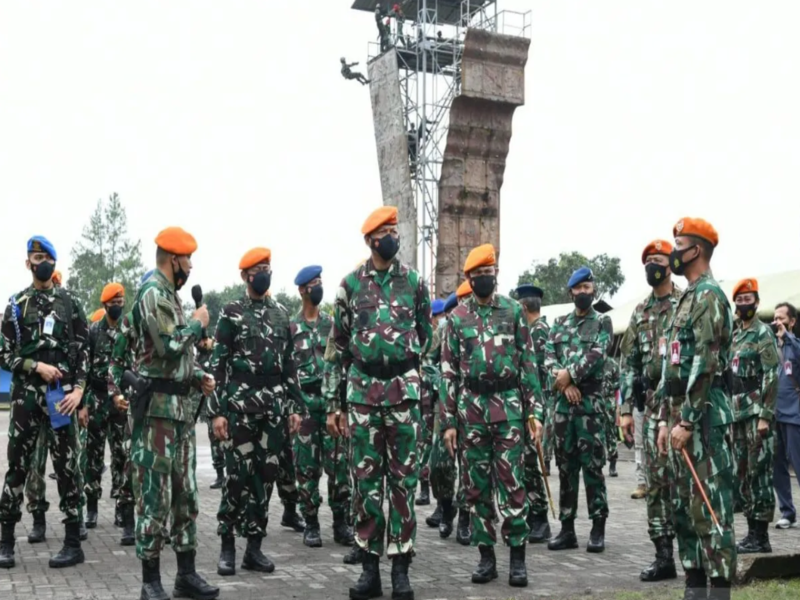
Independent Report – The Working Committee (Panja) meeting on the revision of the Indonesian National Armed Forces (TNI) Law took place from Friday to Saturday, March 14-15, 2025, at Hotel Fairmont, Jakarta. This meeting sparked protests from various parties. One of the critics, TB Hasanuddin, a member of Commission I of the House of Representatives (DPR), confirmed that no further discussions would take place on Sunday, March 16, 2025, at the hotel. He also stated that the discussion on the TNI Law revision would continue on Monday, March 17, 2025, at the DPR building.
Earlier, the Commission for Missing Persons and Victims of Violence (KontraS) criticized the meeting, arguing that the revision of the TNI Law required deeper examination. In response, Utut Adianto, Chairman of Commission I of the DPR, stated that KontraS had opposed the revision from the beginning. He also claimed that the organization’s questions always leaned toward a particular stance.
Utut explained that the DPR had invited KontraS to participate in discussions about the TNI Law revision. However, the organization declined, arguing that their presence would only serve as a form of legitimacy. According to KontraS, legal regulations concerning military courts and other specific areas of the TNI legal system required more urgent attention.
The choice of a luxury hotel as the meeting venue also drew criticism. Some argued that this decision did not reflect the spirit of budget efficiency. Addressing these concerns, Utut clarified that holding meetings in hotels was not a new practice in the legislative process. He described this method as “consignment,” where participants gathered in one place to facilitate discussions.
Utut also compared this meeting to previous legislative discussions held in luxury hotels. He pointed out that the revision of the Attorney General’s Law took place at Hotel Sheraton, while the Personal Data Protection Law was drafted at Hotel InterContinental. According to him, criticism of the meeting venue should also apply to these past legislative discussions.
Also Read : Bank BJB Ensures Business Activities Run Normally
One of the key aspects of the TNI Law revision concerns the extension of the retirement age for military personnel. This policy aims to optimize the use of human resources who remain productive. Extending the retirement age allows personnel who still possess physical and intellectual capacity to continue contributing to national defense.
Farah Puteri Nahlia, a member of Commission I of the DPR, expressed support for this policy. She stated that individuals in their 60s still maintain sharp cognitive abilities and good physical condition, especially TNI personnel who have followed a disciplined and healthy lifestyle throughout their careers. Because of this, increasing the retirement age could benefit both the TNI institution and the nation.
However, Farah also highlighted challenges associated with this policy. One major concern involves the correlation between higher retirement age and personnel productivity. She emphasized the need for stricter assessments to ensure that promotions go to the most competent personnel. A strong meritocracy system must be in place to guarantee that career advancements rely on competency and track records rather than other non-objective factors.
She also stressed the importance of transparency in the promotion system, especially for high-ranking officers at the two-star general level and above, who play a strategic role in defense policymaking. Without proper transparency, promotions might favor certain groups rather than following clear and fair criteria.
From a budget perspective, increasing the retirement age would impact personnel expenses, including salaries, health benefits, position allowances, and other entitlements funded by the state. Therefore, thorough considerations must be made to prevent an imbalance between personnel expenditures and the modernization of primary weapons systems. If not managed properly, the defense budget allocation for improving military capabilities might face significant reductions.
With many aspects still under debate, discussions on the TNI Law revision will continue in the DPR. Policymakers aim to produce regulations that genuinely benefit the TNI institution while ensuring that all changes align with national interests and democratic principles.
Also Read : Judge Rejects Request for 10-Day Objection Plea Preparation
IndependentReport - The latest government policy shifts are igniting debates across continents, with analysts noting that 78% of citizens in…
IndependentReport - Global political observers note a surge in cross‑border tensions as the United Nations reports a 12% rise in…
IndependentReport - The United Nations General Assembly concluded with a historic 78% voter turnout, highlighting escalating tensions in the Indo‑Pacific…
IndependentReport - State-sponsored interference and transnational corruption are reshaping the landscape of international conflicts, with illicit financial flows estimated at…
IndependentReport - Global foreign direct investment plummeted 16% in 2023 according to UNCTAD, signaling a fractured landscape where global government…
IndependentReport - The traditional post-Cold War order is unraveling faster than anticipated. Recent data from the International Monetary Fund suggests…